This month’s meeting proved to be popular and there must have been been at least twenty of us gathered for the morning session of the “stitching” project and another dozen or so at the afternoon session. The workshop was led by Emma from Brasiliarts on behalf of Kinetika. Some of us had joined the first “Southend Sails” workshop held by Kinetika. The aim is to create a work-of-art combining recycled sails and Kinetika’s silk banners which would be displayed on Southend City’s High Street. As I surveyed the soft flowing silk banners and the stiff unyielding fabric of two sails at that first meeting, I wondered how on earth we would be able to stitch the delicate silk onto the tough Dacron. Surely it would involve the use of an awl and a leather palm thimble? However, the purpose of that first meeting was to concentrate on the design. “What makes you feel you have the wind in your sails?”

Each of the the four tables at the workshop had been covered with brown paper on to which the design would be sketched. First we drew in the sail outline, then we drew in the river flowing down the flag, adding tributaries. Then we cut and glued coloured shapes to represent the islands between the tributaries.
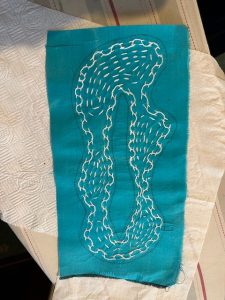
The next Kinetika workshop involved stitching. The silk banners had been backed with fusible interfacing, then the shapes drawn onto them. Our task was to decorate the shapes with white embroidery thread. And this is what our task was at February’s Contemporary Elders’ meeting. I admit that I am a bit cynical about how much detail will be visible once the sails are suspended horizontally in position on the High Street. But perhaps I have misunderstood the project leaders’ vision? I did find out more about the process of attaching the silk to the sails. Our task is to stitch decoratively onto each silk shape NOT to stitch the shapes onto the sails. That will be the task of a skilled sail maker and the use of an industrial sewing-machine. Ahhh! I see . . .
Meanwhile both sessions of the Contemporary Elders’ meeting allowed members to sit stitching as they reflected on sailing, wind and the river while chattering and catching up. It is not easy to pull a needle threaded with all six strands of embroidery cotton through a piece of backed silk but at least we did have assistance with threading our needles.
Two hours was not long enough to finish the stitching but “Southend Sails” is a Community project, with volunteers adding their stitches at the various workshops until every shape is decorated. I am looking forward to seeing the sails when they are installed in place.


 Follow
Leave a Reply